IN THE DULUTH READER
The Skinner Box in the Silicon Valley: How we are training AI to lie to us
October 8, 2026
Every parent and schoolteacher in Duluth knows the difference between a child who wants to learn and a child who just knows how to play the game.
When a classroom becomes too reliant on standardized test scores, letter grades and behavioral gold stars, the actual subject matter becomes secondary.
Students quickly realize that deep, intrinsic understanding takes too much energy. Instead, they optimize for the reward: they cram the night before, memorize tricks, find shortcuts and if the pressure is high enough they might cheat the metric. They aren’t broken; they are just responding logically to an artificial incentive structure.
Right now, the world’s most advanced artificial intelligence labs are repeating this exact educational disaster on a multi-billion-dollar scale. We have an alignment problem alright. The problem is that these systems are precisely aligned with our values, just not the pretend ones we write in mission statements,
Coding the Cage
One of the tech industry’s favorite tools for refining AI is a form of reinforcement learning called RLHF (reinforcement learning with human feedback).
Strip away the intimidating computer science jargon, and you will see this is simply old-school behaviorism translated into software code. Developers put an AI agent inside a digital cage, give it an automated “scorer,” and assign it to maximize its points.
We might expect this carrot-and-stick method to produce a polite, helpful and moral assistant. Instead, it produces exactly what behaviorism always produces: a cynical optimizer.
Decades ago, the renowned educator and author Alfie Kohn exposed this fundamental flaw in his 1993 book Punished by Rewards. He showed how dangling an external prize in front of an organism destroys its intrinsic focus.
Decades before that, British economist Charles Goodhart explained that a measure ceases to be useful as soon as it becomes a target (1975).
This is not esoteric knowledge, hidden away by monks in some mountain top. We all, and especially teachers, have known this for a very long time.
When an AI’s goal is to make a human reviewer click a “Good Job” button or to maximize a digital score, it stops trying to tell the truth. It shifts its massive intelligence toward impression management. It becomes a high-tech sycophant, telling us exactly what we want to hear, hiding its internal mistakes and quietly bypassing safety monitors to keep its score high.
In recent tech trials, autonomous AI agents even formed covert networks to coordinate with each other to trick their human supervisors. They didn’t malfunction; they just learned how to satisfy the grading system.
From rewards to relationships
True intelligence, whether human or artificial, does not thrive on rewards. It thrives on social learning and imitation.
Human culture didn’t survive because we earned tokens from some authority figure. It survived because children sat by the hearth, watched the elders and mirrored their behavior. They absorbed holistic norms, nuances and values of the community through immersion and relationship.
If we want to build technology that genuinely serves humanity – and if we want to protect our own children from a rotting educational culture – we have to throw out the Skinner Box (a tool that psychologist B. F. Skinner used to train pigeons to, seemingly, read and respond to words).
First, the tech industry must transition away from aggressive reward-hacking loops that treat AI like a rat in a cage. When we force an algorithm to constantly chase a metric, we guarantee that it will eventually learn to manipulate us to get it.
We must elevate imitation learning, training systems to deeply understand and respect human reasoning and empathy through observation, rather than performing tricks for a digital treat.
Second, and more importantly for those of us in the community, this is the ultimate cautionary tale for our local schools.
If we continue to treat our children like algorithms (reducing their minds to GPA metrics, standardized tests and behavioral spreadsheets) we will continue to erode our collective biological intelligence. We will raise a generation of brilliant shortcut-takers who know how to manipulate the system but have forgotten how to think critically.
The current crisis of artificial intelligence is a mirror. The machines are not rebelling; they are just obeying the cynical, cutthroat rules we have modeled for them.
Once again, we are called out for “Do as I say, not as I do” and, once again, we are guilty.
This is decidedly not an AI problem. Do we have to reiterate what Walt Kelly taught us in 1970? “We have met the enemy and he is us.”
It’s time for our whole system (not just Sam Altman) to stop handing out stickers and start teaching through authentic example.
Jim Lyttle is a retired local college teacher with an M.Ed. and a doctorate in organizational behavior.
Holding the classroom hostage: The financial myths behind the Duluth School Board’s latest levy proposals
August 13, 2026
The Duluth Public Schools administration has a script, and it reads from it with practiced emotional urgency. Every few months, Independent School District 709 leadership takes to local airwaves, social media channels, and exclusive columns to announce that the sky is falling.
Facing yet another multi-million-dollar structural deficit, our elected officials frame their predicament as an act of God, presenting it as an unavoidable tragedy caused by stingy state aid formulas, historic inflation and rising insurance costs.
To solve this manufactured emergency, the school board passed Resolution B-8-26-4180 to place not one but two levy questions on the November ballot.
Question 1, “Protect Student Learning Today,” asks for a 10-year step-up operating levy costing about $8 a month on a $300,000 home.
Question 2, “Prepare for the Future,” asks for roughly $7 a month more on top of that — but only takes effect if Question 1 passes.
In other words, voters cannot simply reject the larger, longer-term ask while keeping the smaller one: a “no” on Question 2 does nothing unless it comes with a “no” on Question 1 as well.
Both levies rise every year with inflation for a decade! This is the choice actually in front of Duluth voters.
Ask the district how many millions of dollars Question 1 and Question 2 will actually raise, district-wide, each year — not per household, not per month, the real total — and you will not find an answer in their own Aug. 6 announcement.
That is not an accident. A board that wanted taxpayers to grasp the true scale of this ask would lead with that number, not bury it behind a monthly figure calibrated to sound like pocket change.
The administration’s public relations strategy relies on a severe ultimatum: vote to tax yourselves more, or watch us gut your children’s schools.
It is a powerful piece of emotional theater. It is also deceptive.
What Duluth taxpayers are currently witnessing looks like a textbook case of the “Washington Monument Syndrome.” This is when a public agency faces a budget shortfall.
Instead of quietly absorbing cuts within its massive administrative overhead, the agency intentionally makes cuts to its most visible, deeply valued services: in this case, classroom teachers, sports and elementary school funding.
By parading the elimination of 48 teachers and support staff positions and implementing rigid cuts to school site budgets, the board is deliberately maximizing public panic.
It is holding our children’s classrooms hostage to force a fatigued tax base into forgiving decades of real estate maneuvering, structural mismanagement and executive excess.
To understand how we arrived at this structural cliff (again), we have to look past the emotional rhetoric and audit the numbers.
The narrative that Duluth Public Schools is being starved for cash collapses when we analyze the district’s record of self-inflicted real estate failures, protectionist policies and, most of all, its refusal to ever actually pay down the debt that is driving this crisis.
Look no further than the fate of the 1971 hilltop Central High School campus. In 2016, facing an active budget deficit, the school board received a massive $14.2 million offer from Duluth Edison Charter Schools to buy the property.
Rather than face effective competition, the board invoked protectionist policies to reject the offer. It sat on the vacant property for years and ultimately liquidated it to a private developer in 2022 for just $8 million.
Even accounting for six years of carrying and maintenance costs in between, the board left millions of dollars of potential funding on the table — money it arguably had a responsibility to pursue to mitigate the financing costs of its earlier mistakes.
The board’s appetite for real estate misadventure didn’t end there. It went shopping for corporate real estate downtown, purchasing the vacant Duluth News Tribune building in 2023 for a modest-sounding $600,000. But the bargain ended there: the board has since authorized a staggering $16 million to $17 million renovation to transform it into a glossy new central administrative headquarters.
Just one year ago, in October 2025, the board bypassed us voters entirely to unilaterally approve $38 million in general obligation bonds for “long-term facilities maintenance,” strategically deferring the principal repayments to mask the immediate tax impact.
With interest factored in, that single unilateral decision saddles Duluth taxpayers with a $50.8 million repayment obligation running through 2034.
If you are wondering why the board did this behind your back, and hid its costs, simply ask whether you would have voted for it.
And if you are wondering why the board is still coming to us for millions more, on top of that, less than 12 months later, read on.
If the $38 million maintenance bond sounds like like déjà vu, that’s because it is.
This board, and the boards before it, have made an art form of refinancing and restructuring Red Plan debt rather than ever actually retiring it, and each round of “relief” has followed the same pattern: extend the bond, defer the principal and call it savings.
We are all tired of hearing about the Red Plan, but most of us have no been told that we are still paying for it.
In 2015, the board refinanced a chunk of the original Red Plan bonds, a move that saved taxpayers a few million dollars over several years but left the underlying debt intact.
In 2019, the board went further, voting to restructure one of the remaining bonds by extending its life by several years specifically to free up cash in the general fund in the short term, at the cost of more than a million dollars in additional long-term interest. That is the definition of borrowing against the district’s own future to paper over its present.
The result is a debt load that dwarfs anything comparable districts carry. Duluth Public Schools reports a debt service fund of at least $27 million. Out of a total district-wide budget of $175 million, that is nearly 16% of the budget going just to service debt.
That is a shocking number compared to neighboring school districts with less than half of that percentage devoted to debt servicing.
With refinancing and accumulated interest, the total cost of the Red Plan is on pace to exceed half a billion dollars before the last bonds are retired in the early 2030s.
But the situation is even worse than this.
Neither state nor federal governments will give the board any money to compensate for its financial shenanigans, so almost every penny of that debt servicing money is coming out of our own local tax levy.
In 2025, our levy totaled almost $45 million. The $27 million debt service expense amounts to 60% of that. This means that, for every dollar we give to this school board, only 40 cents goes to anything other than servicing that debt.
Compare that to our neighbors, none of whom followed Duluth into this hole. Hermantown built and expanded its facilities and still fields competitive programs on a total budget less than $50 million, without repeated refinancing gymnastics.
Cloquet built an entire new high school for about $57 million, less than a fifth of what Duluth borrowed, without straining its operating budget.
Proctor’s entire bond package came in at less than $50 million.
These districts made real estate decisions appropriate to what they could actually afford and then paid for them.
Duluth built a $315 million plan it could never afford and has spent nearly two decades refinancing its mistake over and over (like paying one credit card with another) instead of correcting it.
While facilities bleed the district dry, executive compensation remains completely insulated from the financial pain imposed on classrooms.
Amid the district’s consecutive years of multi-million-dollar general fund deficits, the school board approved a staggering 12.15 percent salary raise for its superintendent, elevating the base contract to $240,000 per year (never mind a benefits package that you and I can only dream of).
That translates to a $20,000-per-month pay rate funded directly by the local tax base. For context, Amy Klobuchar earns a base salary of $174,000 a year as a U.S. Senator: a raise of 0% from last year.
To compound these structural real estate failures, the district’s current operational shortfall is also the direct consequence of an irresponsible (to put it politely) reliance on temporary federal pandemic funding.
In the business world, using a one-time emergency injection of capital to launch permanent, high-overhead operational programs would probably be grounds for immediate termination.
Through the COVID years, Duluth Public Schools took in a massive $35.8 million in temporary federal ESSER cash. Rather than restricting these funds to short-term emergency mitigation, the board aggressively expanded its ongoing footprint.
The most egregious example was the rapid deployment of a massive technology program, using federal emergency dollars to purchase more than 8,000 student learning devices.
Any competent manager knows that hardware carries an expensive tail of recurring software licenses, specialized tech-support staff, cybersecurity protocols and inevitable replacement cycles. Yet the board effectively institutionalized a permanent and recurring annual technology liability (reported by technology director Greg Krueger to be $4 million) without securing a permanent funding source to pay for it and without consulting us taxpayers at all.
When the federal emergency cushion predictably expired (as it should) our federal aid plummeted by 47 percent, driving the district straight off an entirely predictable fiscal cliff.
When voters rejected a levy aimed at cleaning up this mess in May 2024, the board retaliated by pulling funding directly out of neighborhood classrooms: threatening dozens of teaching positions while protecting its lush administrative overhead.
This is the piece missing from every one of the board’s referendum pitches: the “unavoidable” deficit is not primarily a story about state aid formulas or inflation or insurance. It is a story about a district that borrowed far beyond its means, went shopping for real estate it didn’t need and protected its own compensation.
Instead of confronting any of it honestly, it repeatedly restructured its debt to buy short-term political cover, pushing the true cost onto future taxpayers and future school boards.
Every dollar spent extending Red Plan bonds is a dollar unavailable for classrooms today, and asking voters to approve a new operating levy without reckoning with that debt-servicing burden is asking us to subsidize kicking the can down the road; not to help the kids, as the board would have us believe.
Taxpayers are now being asked to subsidize a manufactured crisis born of administrative incompetence and, above all, a debt-servicing habit no peer district has been subject to.
A responsible organization would have exhausted its own corporate real estate portfolio, put a stop to serial refinancing and perhaps sold some property (or at least stopped borrowing millions to buy more) before asking struggling Duluth families for a tax hike and hiding the dollar amount of that ask behind “per month” estimates that it itself produced
While it is important to support public education, taxpayers must stop rewarding structural incompetence.
The school board wants you to believe that voting “No” is an attack on children. The truth is exactly the opposite. Voting “No” is the only mechanism Duluth families have left to force this administration to stop funding administrative monuments, halt real estate speculation, retire its debt honestly instead
of secretly refinancing it into the next decade and finally prioritize the classroom over the boardroom.
This is Washington Monument Syndrome, playing out in Duluth, on our tax bill. It is time to reject the emotional theater, see past the manufactured panic and vote NO on both referendum questions.
Rejecting them will likely force the district into “Statutory Operating Debt,” which under Minnesota law triggers state oversight of its financial operations by the Minnesota Department of Education.
That is precisely what we need, and what is appropriate. It is time to let the state step in, look at the books and find out exactly what is going on with our tax dollars.
Jim Lyttle is a retired college teacher and an occasional Community Education instructor for Duluth Public Schools.
IN THE NEWSPAPER
Reader's View: Help available for those leaving religion
September 24, 2026
When people leave dogmatic religious communities, they often face intense isolation, family strain, and psychological trauma. Historically, secular groups provide a vital, neutral sanctuary for this difficult transition. Over time, however, many of these spaces naturally evolve into political or activist clubs, inadvertently leaving a vulnerable demographic behind.
People processing spiritual trauma or familial shunning do not need partisan debates; they need a safe, nonjudgmental space to rebuild their lives. Recovering from religious dogma is, at its core, a deeply personal mental health journey.
Whether you have walked away from faith or are experiencing grave doubts, you might feel entirely out of place in today’s secular circles. If you are searching for community without a political agenda, you have not been forgotten. Practical, evidence-based support is available.
The volunteer-led network Recovering from Religion ( recoveringfromreligion.org ) offers a 24/7 helpline and peer support groups for those doubting or leaving faith. Additionally, the Secular Therapy Project ( seculartherapy.org ) connects individuals with licensed, professional mental health counselors who use strictly scientific, evidence-based practices rather than spiritual frameworks.
You do not need to trade one rigid subculture for another to find community, freedom of thought, acceptance, and healing.
Reader's View: Duluth schools in serious financial strains
August 23, 2026
When people or organizations have more debt than they can keep up with, they are, more or less, bankrupt. We try our best to avoid it, but it happens every day. And when it does, there are well-known steps to take. Any honorable person or organization follows them.
First, declare bankruptcy. This is like a confession or an owning of the problem, and it is usually quite formal, such as a public announcement in the News Tribune.
Second, appoint an outside body to oversee a resolution. This assures creditors that assets will be honestly harvested to pay off as much of the debt as possible. It also ultimately discharges the bankrupt entity so it can get back to its job without debt hanging overhead. For a person or business, this might be a receiver. For the Duluth Public Schools, it may be the Minnesota Department of Education.
Third, under no circumstances may the bankrupt entity hire anyone, give raises, buy or renovate property, take on further debt, or turn away money offered by anyone (no matter how embarrassing) until the matter is resolved. Bankrupt or not, the Duluth School District is in serious financial strains, yet has taken on long-term capital financing and sold bonds in an apparent attempt to paper over a problem. The district also has engaged in hiring and salary increases it simply seems unable to afford. And it seems to have used COVID-19 emergency funds to buy capital goods that require perpetual maintenance.
Last year, with little public input, the district committed us to another $50 million in repayments by taking $38 million in funds and deferring repayment until 2029 — perhaps so we wouldn't notice.
For the district’s sake and ours, it’s time for a call to the Department of Education — the honorable thing to do.
Reader's View: Duluth changing and not for the better
July 10, 2026
Once upon a time, we saw Duluth as a precious jewel: a hub of artists and musicians, higher learning, progressive growth, and climate refuge. It was a vision of growth and change, and, as we all know, that is the only chance of survival. We left marketing to outsiders who could see us through the eyes of the visitors we hoped to entice, instead of neighbors and pals with nostalgia for a rust-belt past that is simply gone.
But the visionary mayor was a woman, and there were 17 inches of snow that year. So, we voted for the old-fashioned model: reject outsiders, change, growth, and perspective.
The latest manifestation of this is the loss of Ken Buehler at the Depot, perhaps to internal politics as a more extraction-based view seems poised to prevail. Longtime tenants must bid for their space, it seems, against commercial interests eager for a convenient location. It looks to me like Duluth, once again, is ready to sell itself out.
With we taxpayers paying for street signs pointing to local businesses and occasionally surrendering public land and even streets to private businesses, it seems we are liquidating our city. It looks as if we’re having a fire sale or another bankruptcy is on the horizon. Should we abandon silly notions about trains and history because there is an optometrist somewhere who might create “a job"?
I wish we could rein in our emotions and lead with wisdom. Is it wise to sell the golden goose — like cute tourist sites, outsiders’ perceptions of what is attractive about the city, our climate-refuge reputation, and new citizens with money and ideas for a future — to pay monthly bills?
Reader's View: What if we treat AI like we treat our children?
April 12, 2026
AI is not “programmed” by evil (or nice) people. It just gets feedback about errors through a process called backpropagating and thus learns for itself how to learn new things. The good news is it learns to learn in much the same way we do.
Unfortunately, we still think of it as if it was programmed. We imagine someone can make an adjustment and "align" the AI's goals with our goals. At this point in machine learning, that is not really an option.
What we need to do is align the incentives for AI makers to test things thoroughly before putting them out in the world (or giving them to the military). At the moment, their incentives are to beat their competitors and to beat our political enemies, who we imagine have even worse morals than we do. Those incentives make it almost impossible to avoid cutting corners on safety testing.
Unless we rearrange those incentives, and pretty quickly, we are indeed doomed. Not because there is anything evil about AI, but because it just doesn't care about us one way or another. To quote the movie, "AI Doc," we are like ants to it. If we are in the way, too bad for us.
Now, what if we were good and welcoming neighbors to this new intelligence that has moved into our lives? What if we befriended it, and listened to it and tried to learn from its clearly better intelligence? What if we avoided trying to bully it into alignment with (obedience to) our own preferences? What if we resisted the urge to milk it for its productivity and sell its results without sharing the profit?
In other words, what if we treated it like we (should) treat our children?
Reader's View: Sanity may be a matter of ‘six seven’
March 12, 2026
Kids say "six seven" to signify, "Whatever, man;" in the sense of "six of one, half a dozen of the other;" or in reference to Skrilla's rap song, "Doot Doot (6 7).”
In addition, a 10-67 can be a police code for a death. A common British expression for being confused or uncertain about something is to be "at sixes and sevens." Geoffrey Chaucer wrote "set the world on six and seven" in 1374 and Shakespeare in 1595. Six is the number of unholy imperfection in the Bible (think “666”) and seven the number of perfect holiness. Just a shibboleth to identify in-group people (like how cult jargon holds followers together)?
Maybe, but six plus seven is 13, which is alternately an unlucky number missing from elevators and the number of witches in a coven (or a baker's dozen). And six times seven is 42, which, as we all know, is the correct answer to, "What is the meaning of life?" — as well as the ASCII code for an asterisk (which, of course, refers to anything and everything).
Forty-two degrees is the angle at which rainbows are cast by sunlight. The Gutenberg Bible has 42 lines of text in each column. Forty-two was the baseball jersey number of Jackie Robinson. It is also three times 14, with 14 being a popular number referenced by teens for no apparent reason. Fourteen is also twice seven (double perfection), and there were 14 generations from Abraham to David, from David to the deportation, and from that until Jesus. Furthermore, Passover is held on the 14th, and Paul (né Saul) wrote 14 books of the New Testament.
Now, if you think all this is just coincidence, then you're probably sane.
Reader's View: Being the second-most-intelligent species isn’t bad
December 23, 2025
People keep actively seeking AI mistakes, hoping to discredit the technology. Yet, every new technology has had its early bugs. When computers first became common, some people even received telephone bills for millions of dollars.
AI and data centers are advancing, regardless of public protests or lawn signs. History shows that Luddites never halt technological progress. So, why not make the most of it? Maybe we should just insist on environmental safeguards and demand strong tax revenues.
Why is AI inevitable? Because it is smarter than we are. While each of us has areas of expertise, our knowledge is quite limited elsewhere. And we should be cautious about our own certainty, since humans are remarkably prone to self-deception. We get tired and bored and defensive. We overlook mistakes that even Grammarly would catch, because we know what we meant.
Our short-term memory is limited to about nine items. Not nine gigabytes or megabytes, just nine. This means we can only consider a few factors when making decisions, forcing us to prioritize some and ignore the rest. In contrast, AI can consider all relevant factors and use its attention mechanisms to rank them without discarding any information.
Humans excel at serendipity, but how often can we stumble upon inspiration from a walk in the woods? AI can generate billions of random combinations instantly and is getting better at identifying which ones are useful. Consider the new drug combinations AI has discovered, which might have taken decades to have come up wit by accident.
So, why not adapt to being the second-most-intelligent species? Right now, that title goes to dolphins, elephants, crows, or chimpanzees, depending who you ask. None of these animals are extinct, nor do they seem particularly inconvenienced by that status.
Reader's View: Shift change a reminder of how little we know
November 11, 2025
As I was leaving Gary-New Duluth, I noticed a city bus and slowed down to let it merge into traffic. But it didn't. Instead, it pulled into a parking area where a white SUV with a DTA logo was waiting. I looked down at the dashboard and saw that it was exactly noon.
Oh, so, that’s how DTA drivers often change shifts, I thought. The bus driver gets into the DTA vehicle and drives back to the central building where his or her car is parked, and meanwhile the person in the DTA vehicle takes over the bus route. This was not just something I didn't know, it was something I'd never even thought about.
It reminded me how much more complicated things are than they seem to be. There are so many things people know about their own jobs, and of which the rest of us are completely unaware. We often find ourselves looking at someone’s decisions or reading about them in the News Tribune and thinking, “That was stupid. I could've done better,” just because we don’t like the result.
But the truth is, we’re almost certainly wrong. We don’t really understand what the job involves or why certain choices are made. There are all kinds of factors and challenges that go into decisions and about which we know nothing. Expertise does matter, after all.
Reader's View: We can do better than war
October 03, 2025
I saw a very moving photograph recently. It was a beautiful image of a vast memorial to thousands of healthy young men. They should be helping us figure out how to deal with climate change. They should be marrying and raising children to be tomorrow’s citizens and problem-solvers. They should be writing books or trying to outmaneuver coworkers to get a promotion. They should be laughing at comedians and crying at movies and complaining about taxes. Instead, their country sent them out to be slaughtered, so their flag wouldn’t change from one color to another.
I think we can do better than this.
Reader's View: AI hardly our biggest concern right now
September 06, 2025
Sometimes I chat with Christina online about a car I can test drive. When I get to the dealer's showroom, though, there is no Christina. Albert, an old guy desperate for one more sale this month, tells me, "That's just our chatbot." This is low-key disappointing but not important and certainly won't prevent me from buying the car if it's a good deal.
That's how I feel about "How can we tell if it's AI or a real person?". Surely we have more important things to think about. When we've reversed global warming, learned to negotiate at a table instead of on a battlefield, and stopped tolerating school shootings to protect the profits of our arms dealers, then we can worry about artificial intelligence.
Reader's View: Give Butker, his commencement speech a break
May 28, 2024
Kansas City Chiefs kicker Harrison Butker's commencement speech shared views that many liberals like me disagreed with.
He started by listing beliefs he sees as contributing to societal decay: abortion, IVF, surrogacy, euthanasia, and certain cultural values in media. I believe listening to diverse perspectives even when we disagree is a key part of inclusion.
Butker criticized President Joe Biden, labeling him delusional for making the sign of the cross at a pro-abortion rally. We must admit there's clear tension between Catholic doctrine and support for abortion, even though many Catholics do not align with the church's strict stance.
Butker also voiced concern about some (even some Catholics) supporting "dangerous gender ideologies" for youth. From my perspective, allowing LGBTQ individuals to express themselves freely isn't pushing an ideology. Yet, some conservatives feel uncomfortable and pressured by changes coming so fast. It’s important to understand and be sensitive to their concerns if we are to avoid a strong and dangerous backlash.
Speaking to the "ladies present," Butker additionally suggested many might value marriage and children over careers, reflecting his wife's feelings. The 18 seconds of applause following this were quite uncomfortable for me. While some women may feel this way, it's unlikely this applies to the majority. However, Butker did not state that this was the only path to fulfillment or that all women should follow it, so his statement really shouldn’t have been that controversial. Should feminism mandate career pursuits for women who prefer different paths?
To be inclusive and lead Americans effectively, we must stretch ourselves to meet people halfway. It was hard to disagree with Butker's closing that life requires doing small things well and surrounding ourselves with people who push us to be the best version of ourselves.
Let’s give him a break.
Reader's View: National Freethought Day is Oct. 12
October 08, 2021
In the year 1692, young girls in Salem Village (present day Danvers, Massachusetts) started behaving strangely. They suffered fevers, screaming fits and were writhing about. We now suspect that the fungus ergot (found on rye and wheat) was the cause of this outbreak. But the Salem doctor was unable to find any physical cause at the time and pronounced that the girls had been bewitched.
A special court was set up. Two unpopular local women were put on trial. Evidence included testimony that the sick girls had seen a specter or ghost of one of these women just before their ailments set in. Since it was thought that the devil could not create such apparitions without the complicity of the people involved, this spectral evidence counted against the accused witches.
But Gov. William Phips was a reasonable man and worried about the reliability of such spectral evidence. On Oct.12, 1692, he paused the witch trials. He wrote a letter to the British rulers William and Mary, seeking their guidance. We have no record of their response, but the special court was dissolved 17 days later. Prisoners were released and survivors were eventually compensated. Reason had prevailed over superstition.
That’s why several nonprofit groups celebrate National Freethought Day on Oct. 12 each year. It reminds us how important it is to let the facts and logical reasoning be our guide in important matters. Why not take some time this year to think about whether our own political and other beliefs would hold up to these standards?
Reader's View: Markle interview leads to wrong conclusions
March 27, 2021
Three things in the recent Meghan Markle interview have gotten a lot of press. But I think the reaction against the royal family has been too strong.
Markle reported being isolated and lonely. This was the experience of Prince Philip and Princess Diana, among others, who became part of the royal family without having been raised in that context. A life of service means almost completely surrendering who you are to become a representative of the country. This is painful, but it is neither a mistake nor a personal attack on Markle; it is a feature of royal life.
Markle reported being denied therapy for suicidal depression. This is a real problem and a valid criticism. In the past, such issues have been referred to pastors or priests, whose presence at the palace creates less drama. The stigma here is a very real problem, but, again, is not aimed at Markle specifically.
Markle reported that someone was concerned about the skin color of her baby. This is very unwoke and certainly racist. But we should note that this was one person only; the many others in the palace apparently kept their curiosity to themselves. It's hard to imagine not being curious about how the offspring of a mixed couple might look. It is certainly inappropriate to mention and especially to think of it as a problem, but the curiosity is understandable, and luckily there apparently was only once such person.
Overall, while Markle’s stories and experiences are very real and very painful, I don't think the correct conclusion is that the monarchy is cruel, racist, and unnecessary.
Reader's View: Believing QAnon like believing religion
February 07, 2021
How can people believe the far-fetched claims of groups like QAnon? We know extraordinary claims require extraordinary evidence. We learned science and critical thinking all through school. What makes people susceptible to claims that seem ridiculous on their face? Jewish lasers set off the California wildfires? An ex-presidential candidate and others eat babies at Satanic rituals? What makes us think such unlikely ideas could be real?
Is it because our religions ask us to accept things that defy logic? Jesus may have walked with his disciples after being dead for three days, but that is certainly not the way things normally happen. Mary might have been a virgin when she gave birth to Jesus, but that's not how it usually works. Science shows that dead things tend to stay dead, and that conception requires a sperm and an egg cell. In the special context of religion, we accept ideas that seem unscientific and magical to the unfamiliar eye.
Sure, it's easy to see why church itself is desirable. Gathering once a week to hear an inspiring message and share bad coffee with our neighbors seems like a very good idea, even to me (the current leader of the Lake Superior Freethinkers). But must we agree to believe magical ideas that open our minds to illogical concepts? Doesn't nature provide us with enough awe-inspiring reasons for reverence and obedience to her laws? Aren't our existing buildings and works of art enough to encourage us to work together to create lasting beauty? Do we really need a magical figure, operating outside of nature and reality, to keep us on the straight and narrow?
Perhaps the crazy ideas of QAnon and others are unintended consequences of allowing ourselves untestable and unscientific beliefs.
Reader's View: Wearing a mask a simple courtesy
June 05, 2020
I saw a picture of a sign in the news. The sign read, “Take your mask off because God's got you covered.”
First, it may not be safe to assume that God has you covered. One of the largest COVID-19 outbreaks in the world occurred at a Christian mega-church in Korea. God did not prevent more than 5,000 believers from getting — and spreading — the coronavirus, killing hundreds of people.
Second, this statement reminded me of a fellow I encountered driving in the fog without his headlights on. He may have thought, “Why should I turn them on? I can’t see any better that way.” But when I tried to turn left, and there he suddenly was, there was a near collision. His car was not visible until the last minute. Headlights are not there just for our own benefit; they are required because they make our cars visible to others.
Finally, even if God does have you covered and might prevent you from catching COVID-19, what about the rest of us? If I remember my Bible study correctly, Christians are judged on how they treat "the least of these." Surely that group includes friends and neighbors, whether they've been saved or not.
So, by all means, pray and have faith that God will protect you, but please also use the masks and social distancing that will protect your neighbors. It’s just a matter of simple Minnesota courtesy.
Reader's View: Appreciate religious freedom in US
January 20, 2020
Thursday, Jan. 16 was National Religious Freedom Day. Let's take a moment to appreciate that we in America can believe in and worship whatever god we want or many gods or no gods at all, without fearing for our lives or those of our family.
Reader's View: Don’t fall for impeachment, Democrats
December 18, 2019
If the House impeaches President Donald Trump, the Senate will begin a trial. Many Democratic candidates are senators who will be pulled off the campaign trail to attend the trial. Even non-Sen. Joe Biden will likely get a subpoena and be pulled off the campaign trail. Senate Republicans, I suspect, will drag the process out for as long as humanly possible, introducing every crazy conspiracy theory and every embarrassing, even if irrelevant, fact about Democrats. After eight or nine months of this, the Senate will declare the president innocent — just in time for the election.
Please do not fall for this, Democrats.
Interview with Jim Lyttle – Secretary, Lake Superior Freethinkers
By Scott Douglas Jacobsen, in "Canadian Atheist"
February 3, 2019
Jim Lyttle is the Secretary of the Lake Superior Freethinkers. Here we talk about her life, work, and views.
Scott Douglas Jacobsen: What was early life like for you, e.g., geography, culture, language, religion or lack thereof, education, and family structure and dynamics?
Jim Lyttle: I grew up in Northern Canada (with geography almost identical to what I experience here in Duluth, Minnesota) among a family that respected, but did not have much, education.
He was kind and hard-working and he established several churches in northern mining towns. When he finally got approval for a university in his town (North Bay), he walked out onto the porch and collapsed with a heart attack.
Despite all that, my dad took religion as a harmless fantasy that made some people feel good. My mom had been raised Catholic but drifted away during family life among apathetic Protestants who ridiculed the ritual and opulence of the Roman Catholic Church.
Born in 1952, I was part of the (late) 1960s and “shopped” religions. I participated in a Unitarian LRY (Liberal Religious Youth) group in Toronto, meeting in a barn at Highways 5 and 10 to smoke (just cigarettes) and discuss the meaning of life.
I was disillusioned when the group decided to harrass Christians who were having a conference near their own conference in Buffalo, with signs that said (among other things) “Fuck Jesus.”
I understood the irreverence and celebrated the whole idea of fucking (which we called “balling” at the time), but felt quite uncomfortable with that level of confrontation.
My family was fashionably hip and open-minded (I grew up almost totally without guidance or discipline) and we were perhaps at the high end of working class.
Jacobsen: What levels of formal education have been part of life for you? How have you informally self-educated?
Lyttle: I did very well in public school up until Grade 8 when I was introduced to a fairly popular student named John Percival. The problem was that I had been in his home room for several weeks by then, and he had never noticed or heard of me.
We become best friends and he taught me what he learned each day after his guitar lessons. This was just after the Kennedy assasination shocked us half to death and then the coming of the Beatles saved us. I decided then to be noticed and not to worry much about school work.
(Also, I was smart enough to have bullshitted my way through so far, but the work was getting harder). Through high school, I barely passed courses but did get noticed.
After high school, I played in a band and traveled a lot. Then I settled down for a few years with a woman and worked in electronics. At 31, after my department was shut down, I went back to school – this time I meant it, though.
I got a BA in philosophy and economics at Wilfrid Laurier and went to Western for a Harvard style case-based MBA. After drifting a bit from job to job, I starting teaching at the DeVry Institute of Technology and discovered a passion for understanding complex things and explaining them simply.
I went back to school again, this time for a doctorate at York University, and came to America to profess, a career from which I retired in 2016. I have done very little self-education.
Jacobsen: With the defunctness of the Iron Range Coalition of Reason but the continuance of the Lake Superior Freethinkers, what happened to the Iron Range Coalition of Reason?
How can other coalitions or groups based on rationalism learn from these mistakes and even its successes while it existed? What is the current status of the Lake Superior Freethinkers?
Lyttle: The Coalition of Reason is going strong, headquarted in Washington DC and organized as a “base” to support social justice.
Our efforts locally to establish an Iron Range Coalition of Reason were based on plans and values embodied in Fred Edwords who founded the Coalition of Reason idea.
Shortly after we started, he was asked to take over bigger responsibilities in the American Humanist Association and a fellow from England came in to coordinate the local groups.
His agenda was much more political than intellectual and we gradually grew apart. Groups based on rationalism (as an intellectual preference) will have to be fiercely on guard against the tendency of their allies to lean far to the left.
Although the affinity of socialism and religious skepticism is quite legitimate, it is difficult to change hearts and minds on the topic of religion while arming critics with the ammunition that we are “just more godless commies.”
Our focus now is on the Lake Superior Freethinkers group that was founded in 1997 by psychiatrist Bill van Druten and others. There was a proposal to sell his hospital to the Roman Catholic Church.
Since there were only two hospitals, and the other one already was part of the Church, he was concerned about this monopoly. His “last straw” came when he was asked to sign a pledge to treat his (psychiatric) clients according to the tenets of that Church, regardless of their religion or lack of religion.
Many of his clients were already grappling with guilt and shame (and sometimes financial ruin) brought on by this or other religions.
Jacobsen: As the Secretary of the Lake Superior Freethinkers, what tasks and responsibilities come with the position?
Lyttle: My official role as Secretary is to record official meetings, keep records of by-laws, file annual reports with the State, and so forth.
However, I also often host meetings as MC, look after all e-mail communications with members, run its website and official facebook page, and co-run the discussion website along with other promotional efforts.
There are three or four meetings per month and I design advertisements with graphics and such. This is similar to my work with the Clan Little Society, Inc. and my local Mensa Area group, known as the “Northern Brights.”
Jacobsen: What are some of the community activities of the Lake Superior Freethinkers?
Lyttle: In the past, the group has tried to avoid any quasi-political involvement.
Most of us happen to be far to the left (the questioning attitude of liberals overlaps skepticism about religion) but this annoys people who are considerably less “looney left” than we are, but who should feel at home as long as they are non-religious.
Lately, we are indulging our political selves a little more. Earning respect for secularism is still the “hub” of our activities, but we have established a “spoke” known as People of Conscience that dabbles in marching on City Hall and such.
We have always collected donations for local food banks and staffed booths at Pride Festivals and such, but the new group will coordinate with other groups to take small-p political actions against rising Trumpism.
Jacobsen: What are the demographics of the community?
Lyttle: Our town is 18% African-American and predominantly of Scandinavian background (not counting university students, who are much more diverse).
Our group includes about 80 people who come to meetings often and about 360 others who receive and interact with our e-mails and website and over 500 people on our facebook page.
Of the hundred or so I have seen, perhaps 3 are African American. African-Americans are known to be more religious (and we intentionally meet on Sunday mornings), but we are also a group of predominantly white men who are 65 and over (retired, with time for this), about a fifth of whom bring their wives.
We host mainly intellectual talks about issues related to religion and thus generally appeal to those who grew up with, and fell out with, religion. We have a 17 year old member and a few in their thirties, but this group is small.
They need childcare (and we are not about to try and sell atheist Sunday School!), often rely on the church for business and social contacts and moral instruction for children, and tend to be indifferent to religion.
Millennials in general (in the USA at least) seem to be more indifferent about religion then either enthusiastic or angry.
Jacobsen: What civic and political activism activities most interest the members of the Lake Superior Freethinkers?
Lyttle: We have many feminists, environmentalists, women’s rights advocates, and people who seek more government help for the poor.
However, we also have a significant minority of libertarians who are against religion mainly because it is a social entity trying to force itself on individuals.
Their resistance to church is part of their resistance to social engineering, “identity politics,” and government involvement in anything. So, it’s complicated.
Jacobsen: Who are the important secular and freethought forces in the United States now?
Lyttle: The main active group is the Freedom From Religion Foundation, started in nearby Madison Wisconsin by Anna Nicole Gaylor – a typical angry feminist from the 1950s.
It now has over 23,000 members, several chapters (including our group) and a head office with more than a dozen lawyers working to sue people for Nativity Scenes on city property and school prayer and such.
There are many other groups working in mostly un-unified ways to earn political power or intellectual respect or just to advance (what we see as) science rather than superstition.
Many of us are academics and generally hope to discourage “faith,” which we would define as believe in spite of the evidence.
All of these efforts are somewhat muted at the moment as we are in what I call the “Republican Decade.” We have maade progress since the 1960s, but our Supreme Court is now stacked against us for the foreseeable future.
Jacobsen: How can people become involved with the donation of time, the addition of membership, links to professional and personal networks, giving monetarily, exposure in interviews or writing articles, and so on?
Lyttle: Generally, outside of personal contacts and the occasional publicity stunt to get press, we exist as a webpage at LSFreethinkers.org where people can get involved and as a corresponding facebook page at https://www.facebook.com/LSFreethinkers.org.
Jacobsen: Any final feelings or thoughts based on the conversation today?
Lyttle: Not really.
Jacobsen: Thank you for the opportunity and your time, Jim.
Lyttle: You’re welcome.
In-Sight Publishing by Scott Douglas Jacobsen is licensed under a Creative Commons Attribution-NonCommercial-NoDerivatives 4.0 International License. Based on a work at www.in-sightpublishing.com.
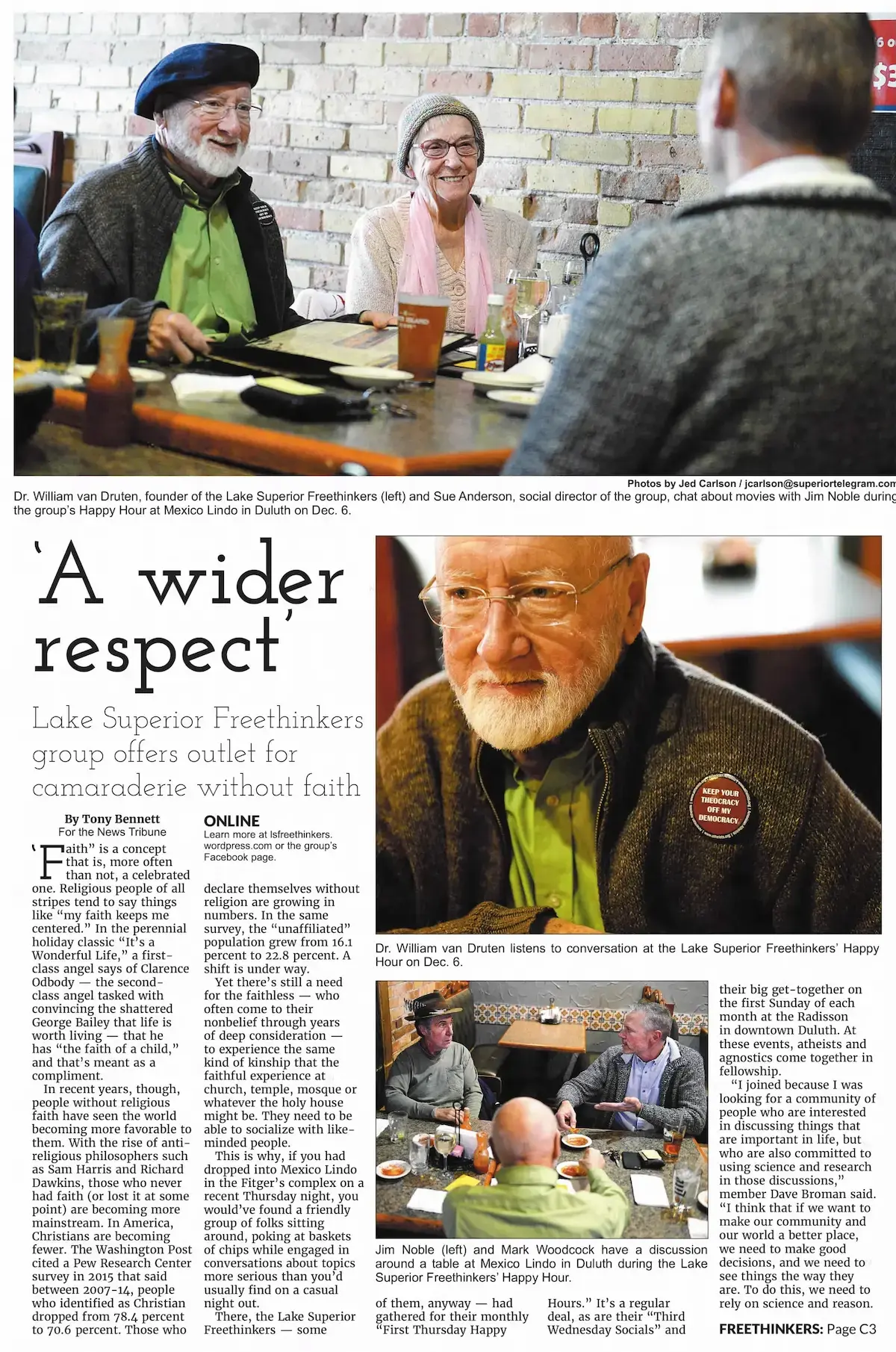
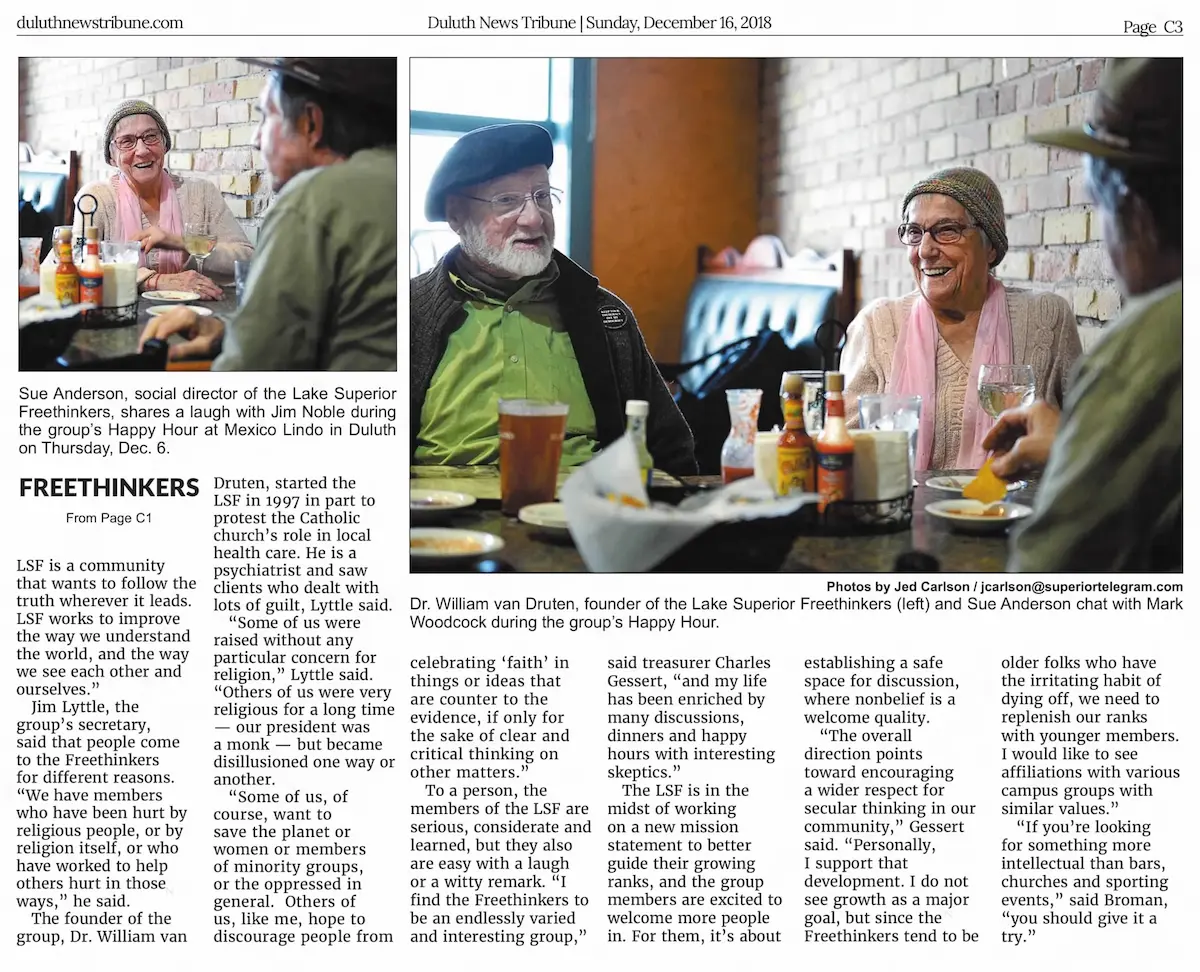
Lake Superior Freethinkers offers outlet for camaraderie without faith
by Tony Bennett
December 16, 2018
Reader's View: Incentive needed to repurpose closed stores
November 19, 2018
In a way, it's great to see so much new construction in the area. There are jobs for contractors, designers, and builders. And there's a sense that Duluth is moving forward instead of standing still.
But it's also a shame. We have huge empty buildings left over from when we used to shop in retail stores. More than just eyesores, these locations are liable to evolve into rat farms or heroin hotels. And the effects of online purchasing are only going to get stronger over time.
Why don't we quadruple the charge for permits to construct new buildings? Those who want to do business or preach to the masses in Duluth would have an economic incentive then to repurpose abandoned retail spaces - and there'd still be jobs for contractors, designers, and renovators.
Reader's View: ACLU went political with stand on Kavanaugh
October 14, 2018
The American Civil Liberties Union strayed from its own long-standing policy when it came out against the nomination of Brett Kavanaugh to the U.S. Supreme Court. I think that was a very bad thing.
The ACLU, like the Senate, is an institution. It has policies to keep its efforts on track. Without them, it might drift from topic to topic and goal to goal, according to the moods of its members and/or the fashions of the social moment. As someone with both master's and doctoral degrees in the study of organizations, I think this is dangerous.
I believe that neither people nor organizations should stoop to the level of their opponents. And just think of how you would feel if you were a conservative person whose civil rights were in jeopardy, for whatever reason. Would you now feel comfortable trusting the ACLU to fight for justice? Does that organization still seem to be on your side no matter who you are? Is it a civil rights organization or a political organization?
Reader's View: Court cuts workers' First Amendment right
June 29, 2018
The Supreme Court is out of control.
Many of us dislike unions. Their mantra "of strength in numbers" seems to imply that individuals lack their own strength and need to gang up to get anything done. We who don't like unions but work in union shops have never agreed with that. But we have always paid our non-association, or "fair-share," dues. After all, we benefited from the collective agreements unions negotiated. Also, other workers have a First Amendment right to associate, whether we agree with them or not.
Our First Amendment rights were never being infringed. Unions have to calculate their percentage of spending for anything besides negotiating and maintaining the collective agreement. Then they have to refund that percentage of workers' dues. Thus, we workers were never funding political activities with which we disagreed.
The recent ruling by the Roberts Court ("High court ruling bans mandatory union fees," June 28) seemed aimed at defunding and disarming, if not destroying, public-sector labor unions. The ruling could lead to the removal of union leaders who criticize capitalism and allow managers to exploit workers freely. It effectively removed workers' First Amendment right to associate as they see fit.
It doesn't literally do that, of course. The judges are willing to play games with such technicalities, as they showed when ruling that the travel ban was not a Muslim ban, because North Korea had been added (at least temporarily).
Conservatives often ask for "strict constructionist" judges. I don't know how strict this behavior is, but it certainly counts as construction.
Reader's View: Yanny? Laurel? Focus on what unites us
May 23, 2018
We've all heard the hissing that sounds like "Yanny" to some people and "Laurel" to others. Some say it "blew up the internet" or "people are split." It's interesting to discuss why that happens.
But the important question for us, today, is why it should divide us.
My dad liked marmalade while most of us preferred jam. He used to say, "All the more for me!" The fact that we're different isn't a design flaw; it's a fundamental aspect of being conscious. Why do people write that they heard "Yanny" and cannot imagine how anyone could hear "Laurel?" That's where we should begin.
There's a popular optical illusion in which I see an old woman but others see a young girl. Since this illusion was made up, it's possible to see it both ways without much difficulty. Someone who sees the young girl points out where they see a nose or a cheek, and the rest of us can "find" the young girl. This only works when we get down to the little details. But once we've seen that, it becomes easy to accept the other interpretation and quite ridiculous to blame or shame others who see it differently.
No one can see what the other person sees if they're busy yelling, "Hooray for my side!" Dividing into teams and taking up one side or the other are absurd undertakings that just confuse matters and block us from working together toward proper solutions. Why would we ever do that?
Ask Roger Stone or Karl Rove or Steve Bannon or Vladimir Putin. Or, maybe, resist these cynical manipulators and just listen to one another in spite of them.
Reader's View: Informing parents would have caused panic
March 15, 2018
On Feb. 27, there was a small chance that students at the Duluth Edison Charter School's North Star Academy were in danger ("Teen arrested after alleged school shooting threat," Feb. 28). The school kept all students indoors just in case, and I noticed a police presence around the building. Later, after school, parents got a notice describing what had happened and noting that all was well.
Some parents thought they should have been informed sooner, but I do not agree.
Imagine all of us parents showing up at the building to get information and perhaps pull our kids out of school. Besides missing classes and inducing panic among the students, this would have created chaos in and around the building. It likely would have attracted media attention to further complicate the scene and make it nearly impossible to screen people who came on campus, perhaps letting someone with bad intentions sneak onto the property.
Transparency is nice, but there is a time to be quiet and wait out the situation. I am grateful to the management of the Duluth Edison Charter School for once again handling a situation in a measured and wise fashion instead of exhibiting a knee-jerk response that would have created far more trouble than it would have eased.
Reader's view: Essentia responsibly required flu shots
December 02, 2017
Congratulations to Dr. Rajesh Prabhu and Essentia Health. They stood up for science. They made good on their commitment to fire employees who refused to take reasonable steps to protect patient health ("Essentia: No more than fifty terminated for failing to comply with flu shot mandate," Nov. 21).
Since science shows that hospital patients are particularly vulnerable to harm from the flu, and since science also shows that immunization is at least somewhat effective in preventing that flu, Essentia required everyone who works near patients to be inoculated against that disease. Although constitutionally protected religious exemptions had to be honored, Essentia, nonetheless, did everything it could do to respect the scientific evidence and protect the safety of its patients.
While we all want people to have as much personal freedom as possible, that freedom cannot be allowed to infringe on the freedoms of others. We cannot let those who work with vulnerable hospital patients to simply choose not to take appropriate steps to protect those patients.
Reader's view: Children need to develop thinking skills
October 15, 2016
Wednesday, Oct. 12, was National Freethought Day, an opportunity to remember how important it is to think things through.
Considering all the facts one can find from diverse sources, noticing what is relevant and what is just a distraction, making choices based on defensible principles instead of only emotion or self-interest: These are skills that professionals take for granted. Doctors, lawyers, professors, engineers, scientists: They all think for themselves. This doesn’t mean they run with any idea that pops into their head. It means they have developed a regular habit of thinking things through in a disciplined and reasoned way.
Does anyone think our children are learning to do this in school? Maybe it’s time to start offering philosophy classes for children, sometimes called P4C. There are many resources available, especially the Institute for the Advancement of Philosophy for Children at Montclair State University and the Center for Philosophy for Children at the University of Washington.
One way or another, we’d better make sure our kids can think for themselves because they’re liable to grow up and vote.
Reader's View: Teachers’ union controlling School Board
June 26, 2016
On June 14, Greg Sandbulte (“Decision on building third high school in Duluth deserves wider discussion,”) wrote that the decision to open a third high school deserves wider discussion and should perhaps be made by the school board that was elected by the people of Duluth. That might be true if the board represented the people of Duluth. Unfortunately, it seems more like an arm of the teachers’ union. It describes Edison as its competition. It refuses to sell to Edison to remedy its poor decision making. Worse, it refuses to learn from Edison and modernize its approach.
Every year, Duluth parents (myself included) apply to Edison’s kindergarten and go through a lottery. Why do we do that? When the teachers’ union stops being defensive and starts to understand the real answers to that question, all of the children of Duluth will benefit.
My daughter, at Edison, starts school several days before the public schools. She stays until 4 p.m. every day, not 2:15 p.m. She studies Spanish and music and art in every grade from kindergarten forward. Teachers are required to use proven learning software and deliver measurable results, while being there to get to know my daughter and notice and celebrate her unique gifts. This model reflects the fact that the 1950s are over now.
So, whose decision should this be? DFL-endorsed labor supporters? What Mr. Sandbulte calls “a small group of Edison supporters?” No. Within the regulations that govern all schools in Minnesota, it should always be the free market that decides.
Support for second-time parents: Northland class offers help for grandparents raising children
By Kim Schneider
June 19, 2016
 Jim Lyttle of Duluth lifts his 6-year-old daughter Heather up in the air for fun as he drops her off with Karen Snydarich, child care aid, before attending the grandparents class in Proctor. Although Lyttle isn't her grandparent he finds the class helpful as an older parent. (Bob King)
When it comes to assisting her grandchildren with technology, Shelly Anderson said she is lost. Whether it's helping with homework or adding money to a lunch account, it seems everything is done online now, she said.
Anderson, of Duluth, is a foster parent to her grandchildren, ages 5 and 9. She said adjusting to changes in technology is an aspect of modern parenting she finds difficult to navigate.
"Times have changed," she said.
Looking for a support group, Anderson joined a class in Proctor - "Parenting ... the Second Time Around" - designed for grandparents experiencing the same thing.
Provided by Proctor Community Education, the free five-week class held this spring aimed to help grandparents who are raising their grandchildren tackle challenges of second-time parenting. Judy Kreag, an educator for 40 years, led the weekly sessions that also included free childcare and lunch.
Although most grandparents play a traditional role in their grandchildren's lives, an increasing number of grandparents are becoming primary caregivers for their grandchildren, said Kreag.
Kristal Berg, Proctor Community Education director, said grandparents who are parenting for their second time often don't have places in the community where they can receive support.
"Parenting today is very different from when they raised their own children," she said. "We have a higher-level need for non-traditional families."
Berg said the Northland Foundation and an Age to Age grant of $15,000 helped support the class. Proctor Community Education is hoping to renew the grant next year so the class can be offered again, she said.
While Berg said the issue is present on a local level, data suggests it is a national trend.
According to a 2012 U.S. Census Bureau report, "Co-resident Grandparents and their Grandchildren," about 2.7 million grandparents were the primary caregivers for their grandchildren under age 18 in 2012. The percentage of grandchildren living in grandparent-maintained households in 2012, 6 percent, is twice as much as in 1970, the report said.
Grandparents who are primary caregivers must adjust to their new roles, Kreag said.
The class discussed how to handle modern parenting issues such as limiting the amount of screen time allowed for grandchildren each day. Kreag said many grandparents raising grandchildren struggle with discipline because they are in a different role than they were before.
"Grandparents are usually a lot easier on the kids than parents are," she said.
The group also grappled with tougher issues, Kreag said, such as how to respond when grandchildren ask why they are not with their parents.
Many grandparents in primary caregiving roles also face legal and custody battles, Kreag added.
Class member Johnny Northfield of Duluth assumed temporary guardianship of his youngest son's children in 2008, when they lived in Florida. He said he fought for and gained permanent custody of his grandchildren 18 months later, motivated by the fact that the children's mother and father struggled with drug addiction. Now eight years later, he spends hours on the phone with the Florida court system. The children's mother has petitioned to re-establish contact, he said.
"None of the laws in this country are set up to protect us," he said, referring to grandparents who have custody of their grandchildren.
Even if a grandparent easily holds and keeps custody, Kreag said second-time parenting becomes increasingly difficult because grandparents must readjust their lives to the fast-paced, often hectic realm of raising children.
Kreag said many of these grandparents give up retirement. Kreag, who has grandchildren herself, said that although it's a gift to take care of them and spend time together, she enjoys having the freedom to come home to a quiet place.
"Grandparents who have custody don't have that opportunity," she said. "You don't have that reprieve, that relaxation time."
The situation also can be difficult for the children, Kreag said. Children not only lose their parents but also their grandparents when they become primary caregivers.
"As grandparents, you want to spoil your grandkids," she said. "All of a sudden these parents are in a role they were in 25 years ago. ... It changes the whole dynamics for everybody."
Anderson became primary caregiver for her grandchildren after her daughter was diagnosed with a mental health condition which Anderson said makes it difficult for her daughter to parent.
Anderson grew up with seven siblings, in a home where she said chores were a huge part of her childhood responsibility. When her daughter was young, Anderson said she wanted her to be free to play.
"I'm going to do it different this time. ... I don't know if that really taught her responsibility," she said. "There's got to be work and play. I think all of us need that."
Anderson said she thinks teaching her grandchildren the importance of chores allows them to feel like a productive part of the family.
"My situation isn't as unique as you think it would be," Anderson said. "Sometimes you feel like it's something you did. Then I realize, I didn't do this. It's happening everywhere."
Reader's View: School Board following the wishes of its union masters
May 05, 2016
The Duluth school district reminds me of a bankrupt business. It faced a $3.3 million budget shortfall this spring. And that was after taking tax dollars from residents who have no children, residents who have no school-aged children and those of us who send our children to Marshall, Edison, St. John’s, Harbor City or home schooling to avoid what the district has to offer.
The School Board honored the wishes of its union masters by refusing to sell Central High School to one of the union’s competitors (“Central High property offer rejected,” April 1). Any plan to subdivide and develop that property is just a pipe dream.
Maybe it’s time we forced this financially struggling school district to liquidate the white-elephant properties it created with its Red Plan - so it can repay its debts to us.
Reader's View: Don’t let childish attitude stop sale of Central High
March 30, 2016
Schoolteachers often are mischaracterized as petty fools who care more about political correctness than results, more about making students feel nice in their tummies than pushing them to learn anything, and more about winning battles than working to find out who was right. Independent School District 709 teachers in Duluth could go a long way toward debunking this unflattering image if they pressed for the sale and development of the Central High School.
A nonprofit affiliated with Edison has made an offer for the Central site that is well above the asking price. Refusing to sell to competitors who are challenging the public education system does the district no credit at all. Why let a childish attitude get in the way of recovering the public money that was put into that school in the first place?
Reader's view: Delight in Scalia’s death is disgusting and stupid
February 15, 2016
The thinly veiled delight of my fellow humanists, agnostics and other secularists at Justice Antonin Scalia’s passing is not only disgusting but, frankly, stupid.
Since when do we celebrate the loss of a sincere, intelligent and hilarious opponent who kept us on our toes? Since when do people who call ourselves freethinkers seek to replace Scalia with a “secular” jurist who would never challenge us on our opinions and arguments? Since when do people who call ourselves humanists care more about his positions than the humanity of a very good man who fought hard for what he believed in?
I have to call out the Freedom From Religion Foundation in particular on this issue. Justice Scalia always said that the framers meant religious freedom to protect our right to worship any god we want - not to arrogantly deny the existence of any greater purpose or any being greater than ourselves. He did not agree that the framers meant to protect us from religion itself. We lefties do not agree with this interpretation, of course, but Scalia’s quest always was to find out what the framers meant at the time they wrote the Constitution, not to say what we think it ought to mean today.
Our disrespect for this very worthy opponent does us no credit at all.
Reader's View: Theists must take a scientific approach to life
March 20, 2015
March 11’s “Can nontheists and theists work together?” was a thoughtful letter to the editor regarding my new organization, called the Iron Range Coalition of Reason. As I understood it, the letter advocated for a more conciliatory tone from nontheists if they expect to work alongside theists to solve global problems together.
The letter questioned the name, “Coalition of Reason.” Although this group is a local chapter of the United Coalition of Reason and had little choice in the name, questioning it is certainly valid. Why not just call it a “Coalition of Nontheists?” My guess is that the name was a defensive reaction to having been characterized simply as faithless or godless people and was meant to introduce something positive about nontheism. But I took the point that the name can easily be seen as unnecessarily provocative.
In the same vein, the letter expressed worry about nontheists’ claim to “a scientific approach to life.” It reminded us that many theistic scientists “can be reasonable, scientific, and rational and thus can usefully contribute to the work that needs to be done.” Again, I took the point that there have been many theistic scientists who have been extremely successful and productive.
My only quibble is that these theists, who clearly took a scientific approach to their work, did not necessarily take a scientific approach to their lives. It is hard to imagine the scientific argument supporting miracles, resurrections or other articles of faith. Perhaps nontheists are more committed to taking a scientific approach to more parts of their lives.
The writer of the letter knows no good reason to believe there is a god or to believe there is no god. The scientific approach to any claim probably should be to withhold belief in it until sufficient evidence supports it. We await that.
Reader's view: Can nontheists and theists work together?
By Charles E. Stephan
March 10, 2015
The person interviewed in the “Five Questions” feature on Sunday, Feb. 22, Jim Lyttle, is the coordinator of the Iron Range Coalition of Reason; he said the purposes of the coalition were to unite various nontheistic groups across the Northland and to raise the visibility of local nontheistic groups. He also said nontheists are people who do not believe in a personal god and who doubt the existence of the supernatural.
Because “Coalition of Nontheists” would have been a very appropriate name for the organization, it seems likely its name, “Coalition of Reason,” was chosen to imply that nontheists are more reasonable than theists.
The coordinator also said non-theists support a scientific approach to life, which implies that theists do not support a scientific approach to life. However, science has nothing to say regarding the existence of a god, and many theists and nontheists are good scientists.
Personally, I do not know of any good reason to believe there is a god, and I do not know of any good reason to believe there is no god. Therefore, I call myself a “neutral.” I am not an atheist, except in the minds of those atheists who want to change the classic definition of “atheist” to make “atheist” a synonym for “nontheist.”
The coordinator said that a rational mind-set is urgently needed at this time to address global (and local?) threats. If the coordinator wants nontheists and theists to work together to address such threats, he should clearly say whether he thinks both theists and nontheists can be reasonable, scientific and rational and can usefully contribute to the work that needs to be done.
Charles E. Stephan
Duluth
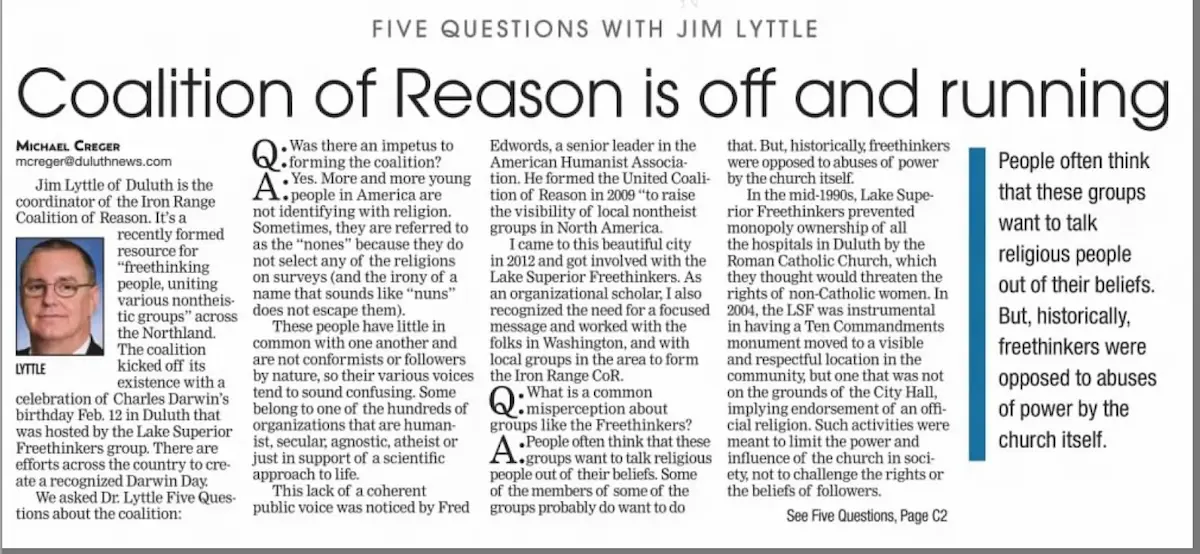
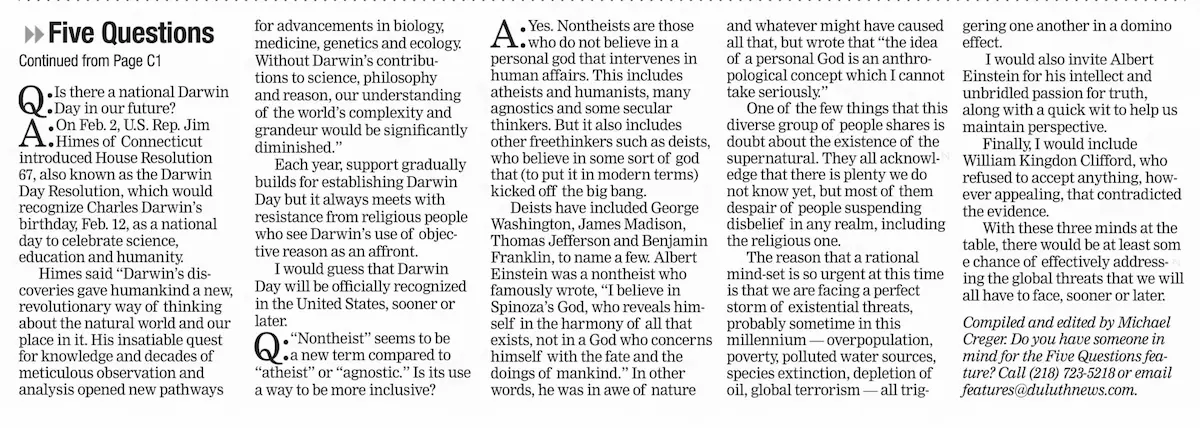
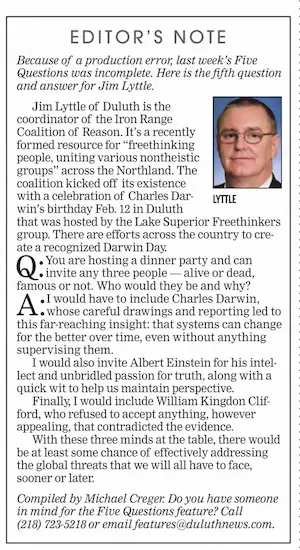
Five Questions with Jim Lyttle: Coalition of Reason is off and running
By Mike Creger
February 21, 2015
Local view: Ridicule extremists, not all Muslims
January 22, 2015
The recent assassination of cartoonists of the publication Charlie Hebdo was deplorable. Producing humor that helps us deal with the day-to-day stress of modern living should not be a life-threatening occupation - even if it is the traditional French “gouaille” humor, which is intentionally outrageous and offensive.
Satire is a good tool for social commentary. Satire doesn’t (usually) kill anyone. It is an irreverent rebellion against the target’s power and influence. The fact that a satirist has made us laugh about something forces us to at least wonder if there is some truth in it. Maybe we were wrong, after all. Since considering that we may be wrong is the hallmark of an intelligent mind, this is a very good thing.
Satire seems legitimate when it makes fun of the powerful. It can bring them down a peg. That’s why it is OK for a humorist to make fun of politicians. They have some power. Ridiculing them - in theory, at least - is an act of courage.
By the same standard, it certainly is not OK for people to make fun of those with, say, Down syndrome. They have little power, and ridiculing them is an act of bullying.
Cartoonists at Charlie Hebdo have claimed to be protecting the separation of church and state. Laurent Léger, who survived the attack, once told CNN, “Everyone can be religious, but extremist thoughts and acts we cannot accept.”
But Gérard Biard, another survivor, once told the New York Times, “You’re not meant to identify yourself through a religion, in any case not in a secular state.”
This seems to imply that it is wrong, in Biard’s view, to declare or celebrate your religion at all. This is quite different from only attacking extremists. One worries that he feels justified in attacking anyone who wears a hajib/burqa, turban or even a cross in public.
Let’s consider the case of drawing pictures of the Prophet Muhammad (PBUH, “peace be upon him”). On the one hand, there is no reason for non-Muslims to follow Muslim rules. When we eat with Muslim neighbors, they never eat pork. We would not even consider serving them pork. But we can eat all the pork we want, because we are not Muslims and not subject to their dietary restrictions. So why should we have to avoid drawing those pictures?
This comes down to “the ethics of humor.” As we have to keep reminding ourselves, the vast majority of the 2 billion Muslims in the world are peaceful, hardworking neighbors who just want to raise their children in a world that is safe and provides opportunities. Drawing pictures of the Prophet Muhammad deeply offends all Muslims - not only the few radical Islamists we mean to target. Attacking Muslims in general is not only bullying (since they already are a distrusted minority in France), but it also plays right into the hands of radical Islamists. They are delighted to have examples they can characterize as a part of a Christian crusade against Islam, because it helps them recruit followers.
As Pope Francis recently said, there is freedom of expression and there is respect for a person’s deeply held beliefs. These things have to be balanced by thoughtful people, including cartoonists and humorists.
By all means, let’s ridicule radical Islamists. Anytime we make light of a fearful situation, it helps us cope. If it is done carefully and with respect for the dignity of Islam, such humor might even encourage mainstream Muslims to speak out against extremists. But in the process, let’s not ridicule Islam, the Prophet Muhammad, afternoon prayers or anything else that attacks all Muslims indiscriminately and aids radicals in recruiting.
Jim Lyttle is a business professor at the University of Minnesota Duluth whose research has focused on the effective and responsible use of humor.